
1946 Penny Value: Why Condition Matters More Than Age
Age alone rarely determines a coin’s worth — 1946 pennies prove that preservation can outweigh decades of existence.
Massive production during the first post-war year created a vast supply of common currency lacking the 1946 penny value in poor states.
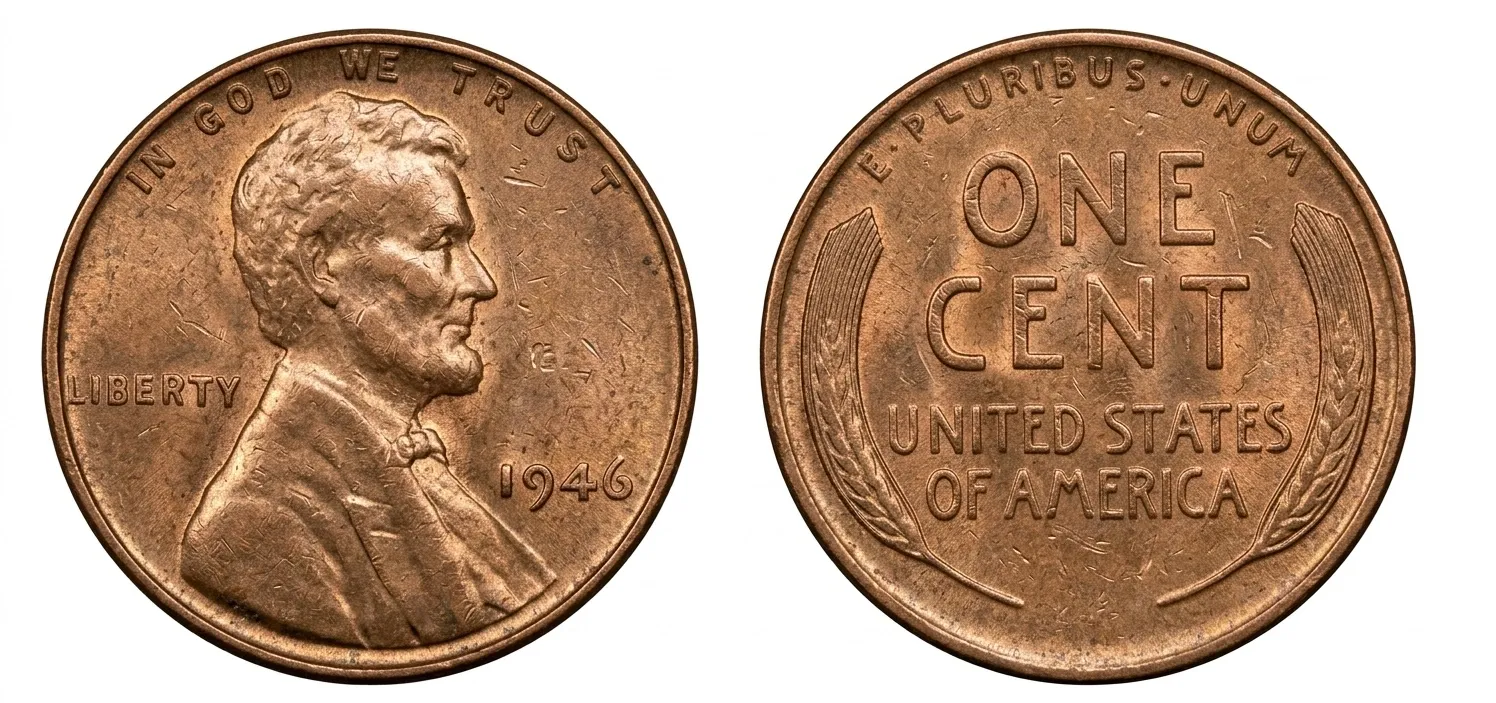
Specimens retaining their original factory appearance represent a rare category of financial assets today.
Feature | Description |
Metal Type | 95% Copper, 5% Tin, and Zinc |
Mass | 3.11 grams |
Size | 19.05 mm |
Front Design | Portrait of Abraham Lincoln |
Back Design | Pair of Wheat Stalks |
Production Volume and Market Availability
Enormous mintage figures make this date common, shifting the focus toward finding perfect surfaces.
Total output across three facilities exceeded 1.5 billion units in 1946.
2026 valuation logic → Surplus of worn coins → Scarcity of MS 67+ grades → High market premiums.
Facility distribution:
Philadelphia (no mark) — 991,655,000 units
Denver (D) — 315,690,000 units
San Francisco (S) — 198,100,000 units
High survival rates for damaged coins keep them at face value for most transactions.
Investment interest targets only those pieces avoiding contact with skin oils or harsh environments.
Copper Surface Changes and Color Coding
Copper reacts naturally with the atmosphere, changing the light-reflecting quality of the metal.
Numismatic industry standards utilize three distinct color categories to define value.
Red (RD) — Minimum 95% original red shine
Red-Brown (RB) — Between 5% and 95% original red shine
Brown (BN) — Less than 5% original shine, mostly dark chocolate tones
Dropping one color tier reduces the market value by a factor of ten or more.
Finding a RD status specimen is a mandatory requirement for selling a 1946 penny above $100 in 2026.
Condition Analysis Using the 70-Point Scale
Professional grading inside the coin scanner app relies on a mathematical system where every point impact the financial outcome.
Damage occurring during circulation permanently removes a coin from the collector category.
Grade | Surface Characteristics | Average 1946 Price (No Mark) |
VG-8 | Heavy wear; wheat details are merged | $0.05 |
EF-40 | Light rubbing on the cheek and hair | $0.15 |
MS-63 | Factory shine present; minor scratches visible | $5 |
MS-65 | High quality; very few production marks | $25 |
MS-67 | Flawless appearance; exceptional luster | $650 |
Statistics confirm a yearly decline in available MS-67 coins as private archives absorb existing stock.
Growth rates for top-tier grades average 8% annually when demand remains consistent.
Mechanical Anomalies of 1946
Beyond surface quality, rare errors occurring during the stamping process add significant value.
Worn-out dies often left faint impressions, creating what specialists call a "weak strike."
Notable production defects:
Repunched S/S Mark — The letter S stamped twice in San Francisco
Die Cracks — Raised metal lines caused by cracks in the steel stamp
Lamination — Layers of the copper alloy peeling due to impurities
Price growth logic: Defect rarity → Low survival numbers → Intense auction competition.
An S/S variety graded at MS-66 RD recently sold for $1,250.
Auction Records and Market Peaks
Actual sales data proves that preservation dominates over the age of the item.
The most expensive 1946 cent from Philadelphia reached a price of $5,581 at a MS-67+ RD grade.
Price trends for top specimens (2020–2026):
2020 → $4,800 2023 → $5,200 2026 → $5,581
Percentage increase over six years reached approximately 16.2% for the highest quality.
Denver (D) coins in MS-67+ quality have realized prices up to $3,360.
San Francisco (S) holds a record of $2,585 for a specimen with exceptional original red luster.
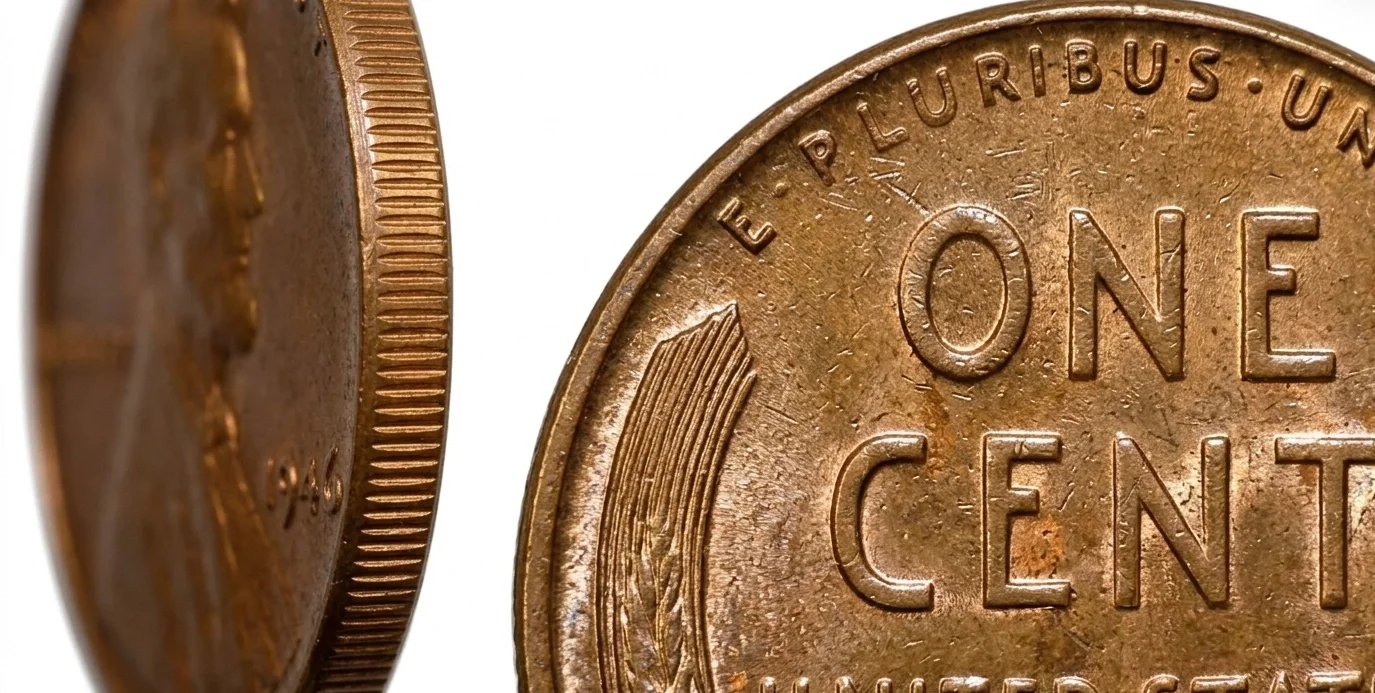
Metal Decay and Preservation Threats
Condition for 1946 pennies remains under constant threat from the active nature of the copper alloy.
Skin contact transfers oils and acids, triggering the start of metal corrosion.
Value destruction chain: Moisture + Air → Oxidation → Change from RD to BN → 90% loss of value.
Using specialized plastic holders prevents air from reaching the metal surface.
Storing coins in PVC-based albums is prohibited due to the risk of sticky green residue forming.
Cleaning coins with chemicals destroys the original shine, reducing the grade to "Details" status instantly.
Comparing Results From Three Mints
Each manufacturing site had unique equipment settings during the 1946 run.
Philadelphia shows the deepest relief due to receiving new steel stamps more frequently.
Denver often produced coins with high shine but many small contact marks.
San Francisco features lower mintage numbers, making the search for RD coins more profitable.
Survival estimates for MS-66 grade:
Philadelphia: ~12,000 units
Denver: ~8,000 units
San Francisco: ~5,500 units
These figures reflect current data from major certification registries.
The Requirement for Professional Grading
Expert evaluation by PCGS or the free coin identifier app serves as the only way to confirm a high market price.
Unprotected coins are considered "raw" and trade at minimum market rates.
Certification steps:
Microscopic visual inspection
Verification of the metal's authenticity
Determining the grade on the 70-point scale
Sealing in a tamper-proof plastic holder
Grading fees can exceed $40 per coin in some cases.
Sending a coin for review makes financial sense only if the expected grade is MS-65 or higher.
Modern Trends in Wheat Cent Collecting
Current efforts focus on finding "hidden" grades within older, unsearched collections.
Many coins certified twenty years ago might receive a higher score during a modern review.
Re-evaluation criteria: Absence of spots → Preservation of shine → Sharpness of the edge strike.
Interest in 1946 coins grows because they represent the first peaceful year of production.
Finding a specimen without a single scratch becomes harder every year despite the large original mintage.